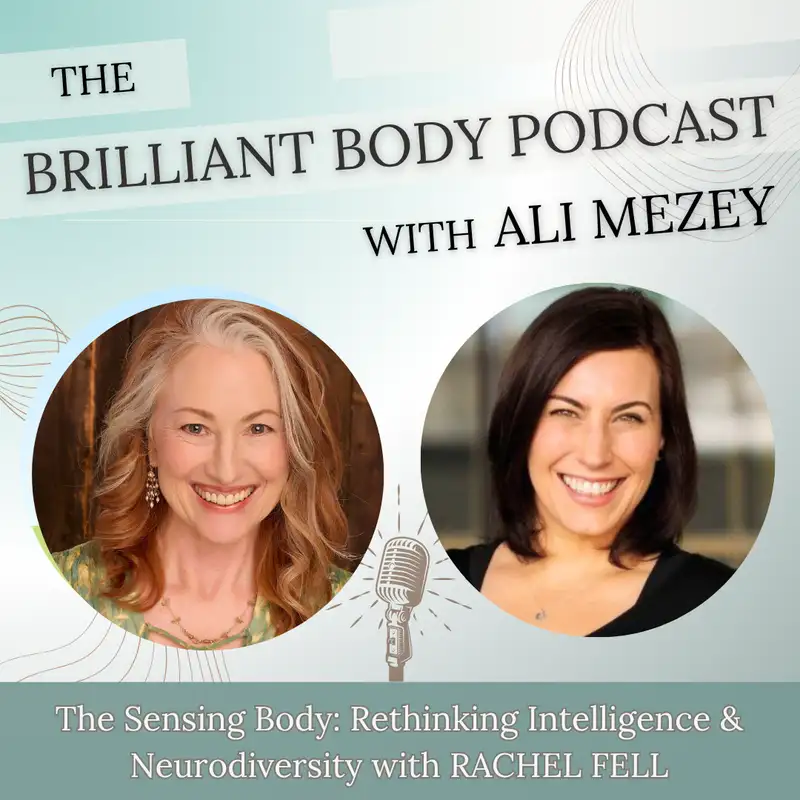
The Sensing Body: Rethinking Intelligence & Neurodiversity with Rachel Fell
SYNOPSIS:
What if intelligence is far bigger than IQ, rational thought, or what we've been taught to measure? In this fascinating conversation, Ali sits down with coach and researcher Rachel Fell to explore neurodiversity as an expression of human biodiversity, challenging our assumptions about what it means to think, feel, perceive, and truly know. Together they venture beyond the limits of our culturally conditioned understanding of intelligence, revealing a far broader way of knowing through our lived experience as sensing bodies.
What if intelligence is far bigger than IQ, rational thought, or what we've been taught to measure? In this fascinating conversation, Ali sits down with coach and researcher Rachel Fell to explore neurodiversity as an expression of human biodiversity, challenging our assumptions about what it means to think, feel, perceive, and truly know. Together they venture beyond the limits of our culturally conditioned understanding of intelligence, revealing a far broader way of knowing through our lived experience as sensing bodies.
Whether you identify as neurodivergent or simply long to feel more fully alive, this episode offers a refreshing invitation to rethink intelligence itself. From trauma, sensitivity, and nervous system regulation to movement, emotion, and the remarkable adaptability of the human body, Ali and Rachel explore how reclaiming our full-bodied intelligence may be one of the most important - and hopeful - frontiers of our time.
To subscribe now, click here
To be an angel to the podcast, click here
To read more about the podcast, click here
FOR MORE ALI MEZEY:
To subscribe now, click here
To be an angel to the podcast, click here
To read more about the podcast, click here
FOR MORE ALI MEZEY:
Website: https://www.alimezey.com
Personal Geometry® and the Magic of Mat Work Course information:
FREE Guided Body Mapping Taster: Heart/Sexuality Split
Five-films series (made by Ali Mezey) on Stephan Hausner’s work with transgenerational influences on illness
FREE Guided Body Mapping Taster: Heart/Sexuality Split
Five-films series (made by Ali Mezey) on Stephan Hausner’s work with transgenerational influences on illness
FOR MORE RACHEL FELL:
BIO: Rachel Fell is a coach, consultant and collaborator working at the intersections of neurodiversity, living intelligence, perception, and embodied awareness.
For over six years she has worked with gifted, neurocomplex, sensitive and intense adults around the globe, co-exploring in the service of full-body intelligence and their unique paths to realization and fulfillment. A published author, speaker, and teacher, she also consults and collaborates with organizations on intelligence and its development, leadership, and brand/identity and business projects.
RELEVANT THE BRILLIANT BODY PODCAST EPISODES:
First Rachel Fell: Bridging Divides with Rachel Fell: Neurodivergence, Conscious Body Awareness & Inclusive Intelligence
Live conversation with Rachel Fell: Neurodiversity, The Body & Inclusive Intelligence: LIVE AUDIENCE Q&A RECORDING with Rachel Fell & Ali Mezey
Panel Discussion: The Democratic Body with Ali, Sarah Peyton, Amber Gray & Rachel Fell
Philip Shepherd, Embodiment Leader & Author: Coming Home to the Body with PHILIP SHEPHERD...Reprised
OTHER LINKS:
Dr Svetlana Masgutova: https://masgutovamethod.com/
Svetlana Masgutova Educational Institute
The Masgutova Neurosensorimotor Reflex Integration - MNRI® Method
Remarkably Bright Creatures on Netflix with Sally Field. Delightful.
An Immense World by Ed Yong
Original Wisdom by Robert Wolff
EXPLANATIONS:
"I think, therefore I am" / Cartesian Divide – René Descartes' famous philosophical statement that placed thinking at the center of human identity. It also contributed to the enduring Western separation of mind and body, often referred to as the Cartesian mind-body split.
Family Constellation Work – A therapeutic and experiential approach developed by Bert Hellinger that explores how unconscious family dynamics and inherited patterns can influence our lives, relationships, health, and sense of self.
Dr. Spock & "Crying It Out" – Mid-20th-century parenting advice, influenced in part by pediatrician Dr. Benjamin Spock and later behavioral approaches, often encouraged allowing babies to cry rather than responding immediately. More recent attachment and developmental research emphasizes the importance of consistent, responsive caregiving for healthy nervous system development.
DEFINITIONS:
Human exceptionalism – The belief that humans are fundamentally superior to, or separate from, the rest of nature and other living beings.
Afferent and efferent – Afferent signals carry information to the brain from the body and senses; efferent signals carry commands from the brain back to the body.
Phenomenology – The study of direct, lived experience—exploring what it feels like to perceive, sense, and exist from the inside.
ARFID (Avoidant/Restrictive Food Intake Disorder) – An eating disorder characterized by extreme restriction or avoidance of certain foods, often due to sensory sensitivities, textures, smells, or fear of negative experiences with eating. It is more common among autistic and neurodivergent individuals.
Synaptic pruning – The brain's natural process of strengthening frequently used neural connections while eliminating those used less often, making learning and development more efficient.
Epigenetics – The study of how life experiences and environmental factors can influence the way genes are expressed without changing the DNA itself.
Alexithymia – Difficulty identifying, describing, or distinguishing one's own emotions. It is common among autistic individuals but can also occur following trauma.
Synesthetic (Synesthesia) – A blending of the senses in which stimulation of one sense automatically evokes another—for example, seeing colors when hearing music. More broadly, it can describe an integrated, multi-sensory way of perceiving experience.
Emotion Wheel – A visual tool that organizes emotions into related groups to help people identify and name what they are feeling with greater precision.
Metacognition – The ability to observe and reflect on your own thinking, learning, and mental processes—in other words, "thinking about thinking."
Neurotypes – The different ways human brains naturally develop, process information, perceive the world, and respond to experience. Examples include neurotypical, autistic, ADHD, dyslexic, and other forms of neurodivergence.
Somanaut - coined by Gil Hedley: "Like the astronaut who navigates outer space, the somanaut is dedicated to exploring the inner space of human form." To listen to my fantastic episode with Gil: Gil Hedley, Integral Anatomist: Your Body Is a Gift